Vistas de página en total

Mostrando entradas con la etiqueta Barbados. Mostrar todas las entradas

miércoles, 18 de marzo de 2020

Quinto país de Europa donde el virus se ha propagado: Suiza. Situación de América Central y El Caribe. Secretismo en Nicaragua.

Suiza, con 8,5 millones de habitantes, es el quinto país de Europa donde el virus se ha propagado más rápidamente y ya se registran 2 200 casos.

Este contenido ha sido publicado originalmente por Diario EL COMERCIO en la siguiente dirección: https://www.elcomercio.com/actualidad/suiza-semi-cuarentena-coronavirus-covid.html. Si está pensando en hacer uso del mismo, por favor, cite la fuente y haga un enlace hacia la nota original de donde usted ha tomado este contenido. ElComercio.com
Suiza, con 8,5 millones de habitantes, es el quinto país de Europa donde el virus se ha propagado más rápidamente y ya se registran 2 200 casos.

Este contenido ha sido publicado originalmente por Diario EL COMERCIO en la siguiente dirección: https://www.elcomercio.com/actualidad/suiza-semi-cuarentena-coronavirus-covid.html. Si está pensando en hacer uso del mismo, por favor, cite la fuente y haga un enlace hacia la nota original de donde usted ha tomado este contenido. ElComercio.com


Vivas donde vivas, por favor sigue las recomendaciones sanitarias.  Se anexan dos manchetas de CrHoy (Costa Rica).


Suiza, con 8,5 millones de habitantes, es el quinto país de Europa donde el virus se ha propagado más rápidamente y ya se registran 2 200 casos, según El Comercio.  Los hospitales podrían colapsar en diez días en ese emblemático país.
 
Swiss hospitals face collapse in 10 days, https://youtu.be/4WWYKRGI2pg

De momento hay 206.664 casos de la enfermedad y 8.272 defunciones a nivel global, según la infografía multimedia a tiempo real, en The Strait Times (Singapur) "How coronavirus is spreading across the world".   

En América Central y el Caribe, Costa Rica es el segundo con 50 casos y Panamá el primer país con 86 casos, siguen: Guadalupe, República Dominicana, Martinica, Jamaica, Honduras, Guatemala, Cuba, Trinidad y Tobago, Puerto Rico, Aruba, Curazao, Saint Martin, St. Barth, Barbados, Santa Lucia, e Islas Vírgenes con más de dos casos.  5 países más tienen ya su primer caso, no es jugando.

Pese a la alarma mundial, el régimen de Daniel Ortega mantiene secretismo sobre la situación en el país, limitándose a decir que está preparado para enfrentar el virus, según La Prensa (Nicaragua).


Las ayudas de Trump del martes 17 de marzo a la economía, que incluye el envío de cheques a las familias, ayudas a las líneas aéreas, etc., no han detenido las caídas de las bolsas hoy 18 de marzo, según reportes de Yahoo Finance.

El precio del crudo marcador de Europa Brent y de Estados Unidos WTI, cayó en picada anoche a un nivel histórico bajo de 27 años.   Y es lógico si no estan volando los aviones, ni hay cruceros, si el comercio marítimo está lento debido a la rotura de la cadena de suministro desde China y la gente está confinada a sus hogares y no puede usar sus vehículos, la demanda de petróleo refinado cae, y con ello la del petróleo crudo.

Tomen precauciones, no salgan de casa, y consulten fuentes con información veraz.  Es el mensaje de su blog Feliz y Saludable hoy miércoles 18 de marzo de 2020, desde San José de Costa Rica.  Rafael A. Vilagut.

viernes, 30 de enero de 2015

Wild Wealth in Costa Rica and CELAC countries


Latin America and the Caribbean: Wild Wealth youtube

Financed by the Inter-American Development Bank (IDB), the documentary was produced by National Geographic film crews who traveled from the Andes to the Amazon to tell five stories that illustrate the need to protect the region's natural resources.
  • Costa Rica
  • Brazil
  • the Andes
  • Barbados
  • Ecuador
All of them, in Latin America, which is the subregion of the Americas comprising those countries where Romance languages are spoken, primarily Spanish and Portuguese. It consists of twenty sovereign states which cover an area that stretches from the southern border of the United States to the southern tip of South America, including the Caribbean. Latin America has an area of approximately 19,197,000 km2 (7,412,000 sq mi), almost 13% of the earth's land surface area.

In Latin America Colombia is characterized by high biodiversity, with the highest rate of species by area unit worldwide and it has the largest number of endemisms (species that are not found naturally anywhere else) of any country. About 10% of the species of the Earth live in Colombia, including over 1,900 species of bird, more than in Europe and North America combined, Colombia has 10% of the world’s mammals species, 14% of the amphibian species and 18% of the bird species of the world.

Costa Rica is also home to a rich variety of plants and animals. While the country has only about 0.1% of the world's landmass, it contains 5% of the world's biodiversity.

Now Latin American Parliament, CELAC is the successor of the Rio Group and the Latin American and Caribbean Summit on Integration and Development (CALC).

As of 2013, its population was estimated at more than 604 million and in 2014, Latin America has a combined nominal GDP of 5,573,397 million USD (almost equal to those of the UK and France combined), and a GDP PPP of 7,531,585 million USD. The term "Latin America" was first used in 1861 in La revue des races Latines, a magazine "dedicated to the cause of Pan-Latinism".

Source wikipedia

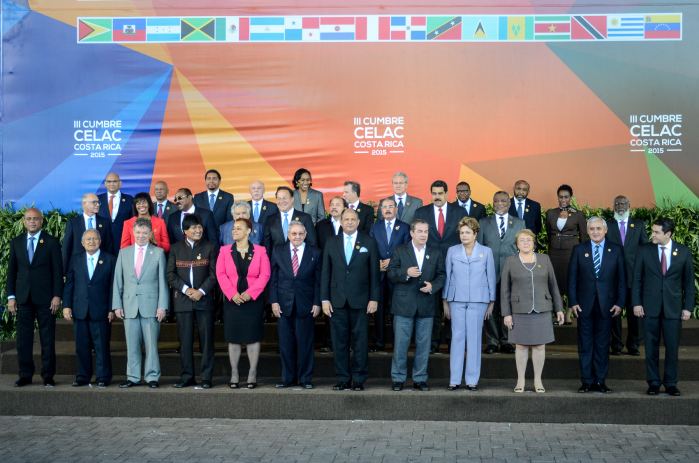
Latin American leaders arrived in Costa Rica last Wednesday to participate in the third Latin American and Caribbean States (CELAC) summit where heads of state from the 33 member countries focused on combating poverty and advancing social inclusion, transparency and accountability. 

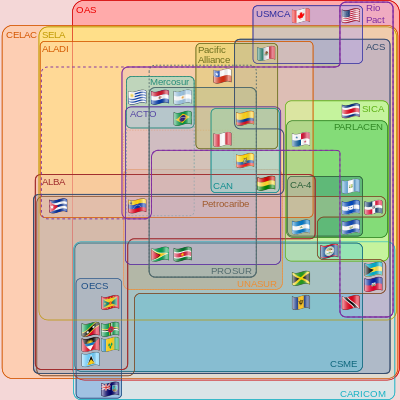
The Community of Latin American and Caribbean States (CELAC) is a coalition of the 33 Latin American and Caribbean nations, and represents around 600 million people. It was launched in 2010 at the Rio Group Unity Summit in Mexico and officially launched with the signing of the Declaration of Caracas Dec. 3, 2011 in Venezuela.


CELAC was established to strengthen Latin American integration and reduce the overwhelming influence of the United States on politics and economics on the region. It was created as an alternative to other political blocs that are dominated by the U.S., such as the Organization for American States (OAS) and the Summit of the Americas – both of which exclude Cuba.

The regional bloc has already had three summits, the first one was held in Santiago, Chile January 2013, the second one in Havana, Cuba January 2014, and the third this week in Costa Rica. Ecuador is set to be transferred the pro-tempore presidency for 2015.

José Mujica: The greatest change in society can only be done with collective force. #CELAC2015


Costa Rican President Luis Guillermo Solís hosted 21 heads of state from across the Western Hemisphere in San José on Wednesday and Thursday for the third annual summit of the Community of Latin American and Caribbean States (CELAC). Visiting leaders included Cuba’s President Raúl Castro, Brazilian President Dilma Rousseff and Uruguay President José “Pepe” Mujica, who received a standing ovation for his plenary speech, his last before leaving office in March. CELAC represents 33 countries in the region that speak Spanish, Portuguese, English and French.

Luis Guillermo Solís said he was pleased with the summit’s accomplishments, adding it was an honor to host the event, after passing the presidency pro tempore over to his Ecuadorean counterpart. Besides hosting the plenary sessions on Wednesday and Thursday, Solís held bilateral meetings with Chilean President Michelle Bachelet, Bolivian President Evo Morales, Colombian President Manual Santos, Haitian President Michel Martelly, and representatives from Jamaica.


Costa Rica is known for its progressive environmental policies, being the only country to meet all five criteria established to measure environmental sustainability. It is ranked fifth in the world, and first among the Americas, in the 2012 Environmental Performance Index. It was twice ranked the best performing country in the New Economics Foundation's (NEF) Happy Planet Index, which measures environmental sustainability, and identified by the NEF as the greenest country in the world in 2009. In 2007, the Costa Rican government announced plans for Costa Rica to become the first carbon-neutral country by 2021, while in 2012, Costa Rica became the first country in the Americas to ban recreational hunting.

Rafael A. Vilagut rvilagut@upssatravel.com
phone 011 506 83206097 Central America


martes, 8 de marzo de 2011

Turismo Feliz

Indice de Competitividad Turística en las Américas 2011


Índice de Competitividad Turística, elaborado por el World Economic Forum, que analiza y clasifica la capacidad de 138 países del mundo para explotar sus recursos de turismo. El país con mayor competitividad turística es Suiza, seguido de Austria y Alemania. Costa Rica está de quinto lugar en las Américas, y en el ranking general de puesto 44 retrocediendo dos lugares desde el año anterior. Estados Unidos, Canadá, Barbados, México, ocupan los 4 primeros lugares en este Continente.

España de 7mo en Europa, después de Suiza, Alemania, Francia, Austria, Suecia, y Reino Unido, también retrocedió dos lugares con respecto al ranking anterior.

En nuestra región, Centroamérica y el Caribe, Barbados 3er lugar, México, 4to, Costa Rica 5to, Panamá 8vo, Jamaica 12vo, República Dominicana 14, Colombia 15, Trinidad y Tobago 16, Guatemala 17, Honduras 19, El Salvador 20, Nicaragua 22 y Venezuela 23. Vía Weforum.

Feliz y Saludable tarde-noche. ¿Cuál es el país mas lindo que has visitado? Si querés nos podés acompañar al Crucero que nos paga Herbalife por el Caribe (Panamá, Colombia, Islas ABC) a finales de año, o a la Extravaganza en Febrero del 2012 en Panamá.  Para cualquier cosa me tienen a la órden en Costa Rica, por el tel (00.506) 83 20 60 97, rafaelvilagut@gmail.com Rafael A. Vilagut.